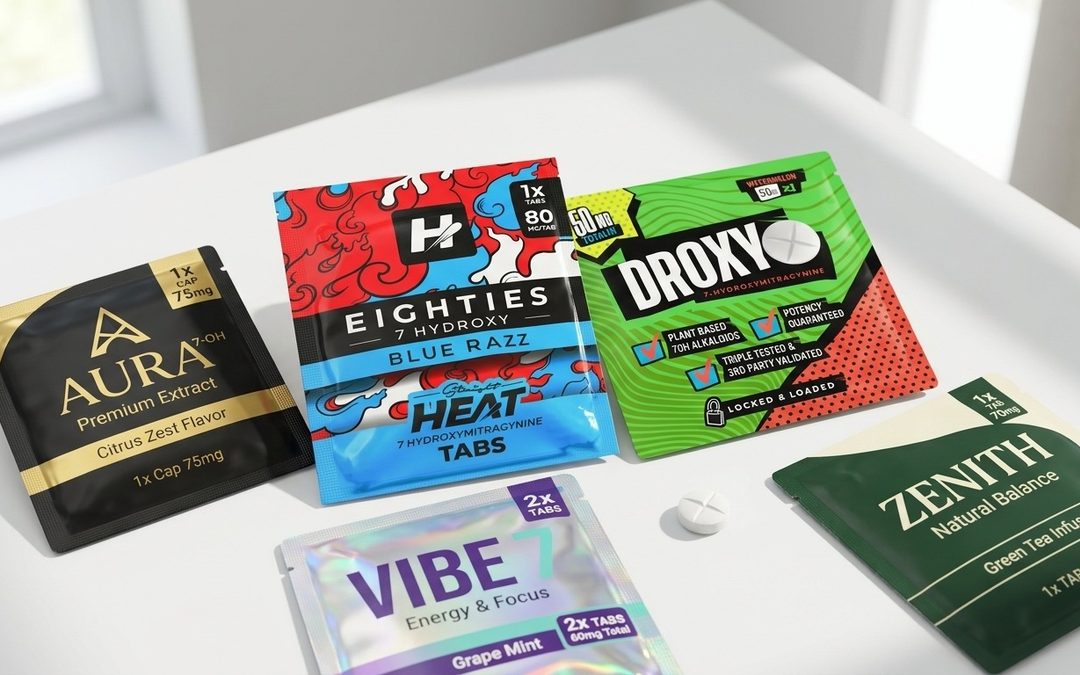
Search for the best 7oh brand and you will find plenty of confident rankings, most of them built on flavor, packaging or claims about strength. Very few explain how they reached their conclusions. The truth is that there is no objective best 7oh brand ranking, and a single retailer’s catalog, running from names like generic rx to Zourz, shows how crowded the field has become. What you can do is compare brands on criteria that can actually be checked. This guide sets out those criteria, shows how two current brands present their labels, and lists the signals that tell you very little.
Start With Label Clarity
A good label answers three questions without making you work for them:
1. How much of the named alkaloid is in each tablet, bottle or serving?
2. How much is in the whole pack?
3. How does the manufacturer define a serving?
Brands differ a great deal here. Some print only a pack total on the front. Others print both the per-unit and per-pack figures, and a few go further and explain how a tablet is meant to be divided.
Sevn’s listings show what a detailed label looks like. The sevn tablets currently listed in a five-count pack state 150mg of 7-hydroxymitragynine per tablet and 750mg per pack. The product description goes on to say that each tablet is designed to be split into four servings, and that the brand emphasizes measured portions rather than whole-tablet use. Sevn’s Mini shot listing is similarly specific: 25mg in a 2 fl oz single-serve bottle.
You do not have to agree with any brand’s positioning to see the value of that level of detail. A label that defines its own serving leaves less room for misreading.
Check the Lab Testing Properly
Almost every brand in this category says its products are lab tested. The claim on its own means little. What matters is the certificate of analysis (COA) and whether it holds up to a few basic checks.
• Independence. The lab should be named and independent from the brand.
• Accreditation. ISO/IEC 17025 accreditation is a widely used benchmark for testing laboratories.
• Batch match. The batch or lot number on the COA should match the pack in hand.
• Full alkaloid panel. A report that lists only the headline compound shows less than one that includes other kratom alkaloids.
• Contaminant testing. Heavy metal and microbial results should be included.
• Flavor-level reports. Different flavors may be made in separate batches, so a report for one flavor does not prove another.
• Date. A COA from years ago does not describe a batch made last month.
A brand that publishes current, batch-matched, flavor-specific reports from an independent lab is giving you something you can verify. A brand that offers a single generic PDF is not.
Look for Consistency Across the Range
Many brands sell several strengths and pack sizes. Look at how consistently they label them.
7Pure is one example of a brand with several pack sizes. The 7pure two-count pack lists 75mg of 7-hydroxymitragynine per tablet and 150mg in total, and notes that each tablet can be divided. The brand has offered other pack sizes over time. When a brand runs several sizes, the per-tablet figure should be easy to find on every one of them, not just on the smallest.
Warning signs of inconsistency include product names that do not match the stated contents, pack totals that do not divide evenly into the stated count, and different strengths sold in nearly identical packaging.
Assess Packaging and Safety Features
Kratom alkaloid products are often flavored like candy and packaged in bright colors. That is a real safety issue, so packaging deserves attention:
• Child-resistant features. Blister packs and bottles vary in how hard they are to open.
• Clear adult-only labeling. Look for 21+ statements on the pack.
• Ingredient lists. Sweeteners, flavors and binders should be listed, which matters for anyone with allergies or dietary restrictions.
• Manufacturer or distributor contact details. A brand that can be contacted is easier to hold accountable.
• Batch numbers and dates. These allow a product to be traced back to a COA and support recalls if needed.
Treat Marketing Claims With Caution
How a brand talks about its products tells you something too. Product copy in this category often promises particular effects. Those claims are marketing, and the FDA has not evaluated any of these products to diagnose, treat, cure or prevent any condition. The FDA has sent warning letters to companies in the kratom space over unapproved claims in the past.
A brand that focuses on measurable information, such as amounts, servings and test results, is giving you more to work with than a brand that relies on adjectives. Disease or treatment claims are a red flag.
Consider Compliance Behavior
Federal and state rules have changed quickly in 2026, and how a brand and its retailers respond is part of the picture.
As of early October 2026, the DEA had published a notice of intent to temporarily schedule 7-OH above a specified threshold, but no final order had appeared in the Federal Register. Mitragynine pseudoindoxyl, MGM-15 and MGM-16 were placed in temporary Schedule I on August 26, 2026, and responsible sellers removed products containing them.
Compliance-minded brands and retailers tend to share some habits: they restrict shipping to states and localities where products are prohibited, they keep labeling consistent with current rules, and they remove products promptly when the law changes. Those habits are easier to verify than any claim about quality.
Signals That Tell You Very Little
Some features get a lot of attention but say almost nothing about what is in the pack:
• Flavor. Pleasant flavors are a design choice, not a quality marker.
• Packaging design. A premium look says nothing about contents.
• “Strongest” or “maximum” language. Strength is a number on the label, not an adjective.
• Price alone. A higher price does not guarantee better testing, and a lower price does not prove the opposite.
• Online popularity. A brand can be widely searched for reasons unrelated to quality.
Using a Brand Directory Sensibly
Retailer brand directories are useful because they put many names in one place, but a directory is a list, not a ranking. Being listed tells you that a retailer carries a brand. It does not tell you how that brand performs against the criteria above.
A directory is best used to see which brands publish batch-matched lab reports and clear labels. Looking through brand pages with the criteria above in mind usually reveals real differences in how clearly each brand states its contents, how current its testing is, and how carefully it defines a serving. Those differences are a better basis for judgment than any ranking you will find online.
A Simple Comparison Checklist
When comparing any two brands, run through the same list:
1. Per-unit amount, per-pack amount and serving definition are all clear.
2. A current, independent, batch-matched COA is available.
3. The COA includes a full alkaloid panel and contaminant results.
4. Packaging is clearly marked for adults and has safety features.
5. Marketing sticks to facts rather than effect or health claims.
6. The brand and retailer follow state, local and federal rules.
7. The product is legal where you live.
A brand that passes all seven is being transparent. A brand that fails several is asking you to trust it without evidence.
Frequently Asked Questions
Is there an official ranking of 7-OH brands?
No. There is no regulator or independent body that ranks 7-OH brands, and the FDA has not evaluated any of these products. Rankings found online reflect the opinions or commercial interests of whoever published them.
What is the single most useful thing to check?
A current certificate of analysis from an independent lab that matches the batch number on the pack. It is the only document that shows what a specific batch actually contained.
Does a long brand list mean every brand is tested the same way?
No. Testing practices vary from brand to brand, which is why each product’s own lab report matters more than the retailer it is sold through.