
An athlete can test blockchain technology without turning a training account into a token billboard. Away from promotional campaigns, some professionals are studying payment rails, contract administration and digital access systems. Their interest is practical: does a tool reduce paperwork, protect earnings or make an existing service easier to use?
The distinction becomes clearer when a player considers the cost of a mistake. A public endorsement can influence supporters who assume sporting achievement implies financial expertise. Quiet experimentation, by contrast, can happen with advisers, small trials and written limits before any money moves.
The vocabulary around crypto covers very different activities. A bitcoin casino, for example, uses digital currency in an entertainment setting; that tells an athlete little about custody arrangements for salary payments or the legal treatment of tokenized royalties. Similar terminology should not replace separate due diligence.
A Private Trial Has Different Rules
For an athlete paid across borders, the practical question is how a stablecoin payout compares with the arrival time of bank funds. The relevant comparison includes conversion fees, local tax records, withdrawal access and what happens if the issuing company fails. A successful transfer on a phone is not a complete audit of the payment route.
Other experiments concern signed memorabilia or controlled entry to a training event. Here the question is whether a digital record improves verification, not whether its resale price rises. Clubs and agents may need to approve the use of names, footage and trademarks.
Three Routes, Three Different Questions
| Use case | Potential gain | Main check |
| Cross-border pay | Fewer transfer steps | Cash-out and tax trail |
| Digital access | Verifiable entry | Recovery for lost keys |
| Licensed collectibles | Provenance records | Media rights and refunds |
An agent should also distinguish a company selling software to teams from one selling an investment story to followers. The first can be evaluated through service uptime and support tickets; the second may depend on attention that vanishes after a losing season.
A Checklist Before Any Public Mention
☐ Has independent legal advice covered the athlete’s home jurisdiction and competition rules?
☐ Can the provider explain who holds the keys and how access is recovered?
☐ Are fees, exchange rates and exit procedures recorded in writing?
☐ Would the experiment still be useful if the token price never increased?
A Small Graph: Exposure Versus Visibility
The illustration below is a hypothetical planning sketch, not survey evidence or a forecast. It shows how publicity can rise much faster than technical learning when an athlete moves from a private test to a paid campaign.
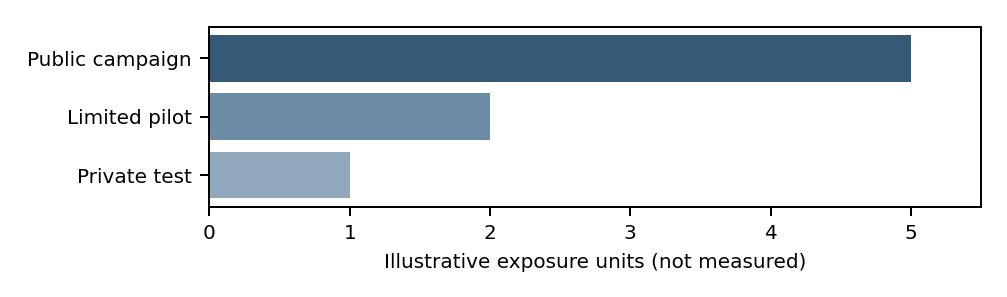
Illustrative only: private test 1, limited pilot 2, public campaign 5
Relative public exposure (arbitrary units)
Why Silence Can Be a Responsible Choice
An athlete might trial a digital ticket credential with a club operations team, discover that supporters struggle with wallet recovery, and abandon the pilot. That unsuccessful test can still produce useful knowledge. Announcing a partnership first would make it harder to stop without confusing fans.
IMPORTANT A blockchain receipt cannot settle questions about consumer rights, licensing or ownership of the underlying media. Those obligations exist outside the ledger and may differ by country.
What Counts as Progress?
The strongest signal is not a celebrity post but a repeatable result: fewer manual corrections, an independently reviewed security process or a service that supporters can use without buying a speculative asset. An athlete can ask for those measures while keeping investment decisions private.
Professional credibility is built over seasons, not token cycles. Treating crypto as one possible infrastructure choice leaves room for curiosity without converting a player’s audience into a customer-acquisition channel.