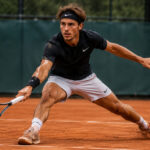
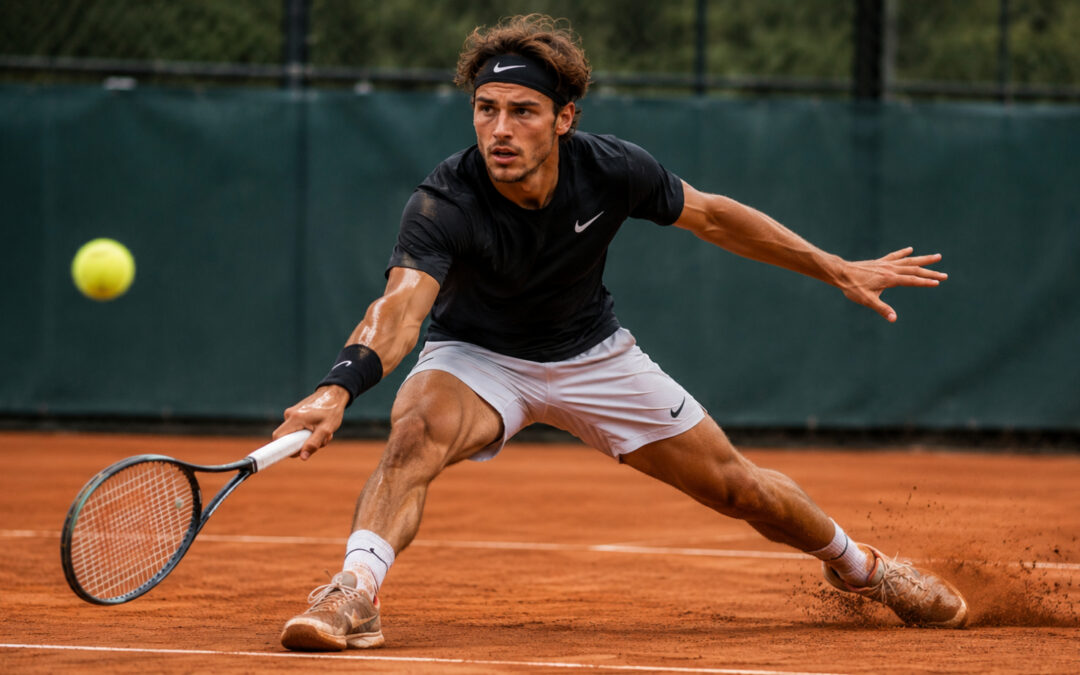
In the high-speed arena of professional tennis, baseline rallies often resemble high-velocity chess matches where shots regularly exceed 100 miles per hour. While spectators frequently fixate on the raw power of a forehand or the explosive spin of a serve, elite coaches know that the true differentiator between a champion and a journeyman happens milliseconds before contact: the split-step. Far more than a simple hop, the split-step is a sophisticated biomechanical maneuver that exploits the stretch-shortening cycle of human skeletal muscle. By mastering micro-timing, professional players harness ground reaction forces to launch themselves toward an incoming ball with maximum acceleration and zero wasted energy.
The Physics of the Stretch-Shortening Cycle
To understand why the split-step is the cornerstone of elite court movement, one must examine the physics of elastic energy storage. When a tennis player executes a small, synchronized hop just as their opponent strikes the ball, they are not merely waiting in the air. As their feet land back on the court surface, the downward momentum combined with active eccentric loading forces the Achilles tendons, calves, and quadriceps to stretch rapidly.
This sudden stretch stores potential elastic energy in the musculotendinous springs of the lower limbs, much like pulling back a slingshot. Immediately following this ground impact, the concentric contraction releases stored elastic energy alongside the neural reflex output, producing an explosive burst of force far exceeding what pure muscular contraction alone could achieve. Without a properly timed split-step, a player’s first step relies entirely on starting from a dead stop, costing crucial tenths of a second in reaction time.
Key Biomechanical Metrics of an Elite Split-Step
Sports scientists utilizing high-speed motion capture and force plates have mapped the precise physical signatures that separate club players from Grand Slam finalists:
- Timing Synchronization: Elite players land their split-step precisely at the exact moment—or a few milliseconds before—the opponent’s racquet strings make contact with the ball, anticipating trajectory rather than reacting to sound.
- Minimal Vertical Displacement: Champions keep their hops remarkably low and efficient (often just a few centimeters off the ground), ensuring that energy is redirected horizontally rather than wasted vertically.
- Optimal Base of Landing: Feet land wider than shoulder-width with flexed knees, immediately lowering the center of gravity and placing the joints in an ideal preload angle for lateral push-off.
- Immediate Weight Transfer: The transition from impact absorption to explosive lateral drive happens in under 150 milliseconds, bypassing unnecessary hesitation.
Mental Decompression and Maintaining Court Focus
The physical intensity of modern tennis requires relentless cognitive vigilance, as players must constantly monitor ball spin, depth, and opponent positioning under extreme cardiovascular load. This hyper-focus creates mental fatigue that can subtly degrade micro-timing and footwork rhythm over the course of a gruelling three-set match.
To protect their cognitive sharpness, elite competitors rely on structured mental resets during changeovers and lulls in play. Stepping away from the relentless pressure of tactical calculation allows the nervous system to recover its baseline sensitivity. For moments of effortless mental detachment, athletes often utilize a brief, low-stakes digital distraction—such as a quick, relaxing session at a crypto casino—to completely clear their working memory and release mental tension. Clearing the cognitive slate ensures that when they step back onto the baseline, their split-step timing remains razor-sharp.
Translating Micro-Biomechanics Into On-Court Dominance
Footwork in tennis is rarely about running faster; it is about moving smarter and initiating motion at the precise micro-moment physics allows. By converting every split-step into an efficient spring-loaded launch, players eliminate wasted motion and buy themselves the ultimate luxury on the court: time.